Tracking Baby Milestones: What to Log and Why It Matters
Why Tracking Beats Memory
Sleep deprivation in the newborn months does more than make you tired — it distorts your perception of time. Parents routinely misremember when their baby last fed, how many wet diapers there were yesterday, or whether that long nap happened this morning or the day before. This is not a personal failing; it is a predictable consequence of fragmented sleep and an overwhelming amount of new information.
Pediatricians ask specific questions at every well-baby visit: How many wet diapers per day? How long is your baby sleeping total? How often is your baby feeding, and how much? These questions have numbers as answers. Guessing is frustrating. Having a log lets you answer with confidence.
Beyond appointments, consistent logging catches gradual changes that feel invisible day to day. The shift from 9 feeds per day to 7 is easy to miss in the moment. Over a week of logged data, the trend is obvious. This matters because feeding frequency, diaper output, and sleep totals are the earliest indicators of how your baby is doing — and small changes can sometimes signal something worth mentioning to your doctor.
What to Track in the First 3 Months
In the first three months, four categories of data are most useful — both for your own peace of mind and for your pediatrician.
Feeding: For breastfeeding, log the start time, which side, and duration. For formula, log the volume offered and consumed, and the formula type. For pumped milk, log the volume fed. These details let you spot cluster feeding patterns, track increasing volumes as your baby grows, and know when supply may need attention.
Sleep: Log the start and end time of every sleep period, including naps. Total daily sleep is the number your pediatrician needs — newborns should average 14–17 hours per 24 hours. Tracking also reveals when longer overnight stretches begin to form, which is one of the most encouraging things to see in the data.
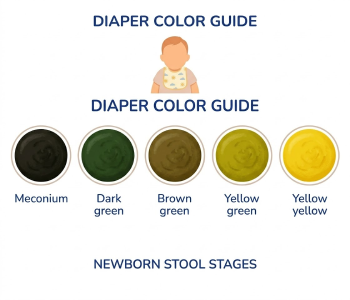
Diapers: Log each diaper as wet, dirty, or both, and note unusual colors. Six or more wet diapers per day from day 5 onward is the clearest indicator that a newborn is getting enough milk. A sudden drop in diaper output is a reason to call your pediatrician.
Health: Log temperature readings when your baby seems unwell, any medications given (type, dose, and time), and notable symptoms — rash, fussiness after a feed, unusual stool color. Having this written down rather than reconstructed from memory is invaluable during a doctor's call or visit.
Developmental Milestones Month by Month (0–6 Months)
Baby milestones by month give you a framework for what to expect — not a checklist your baby must complete on schedule. Developmental ranges are wide, and most babies reach each milestone within a window of several weeks. The purpose of knowing the typical range is to give you context, not to create anxiety.
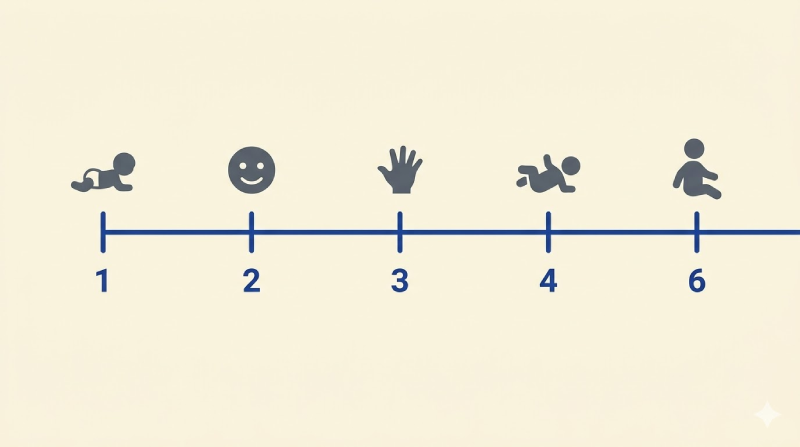
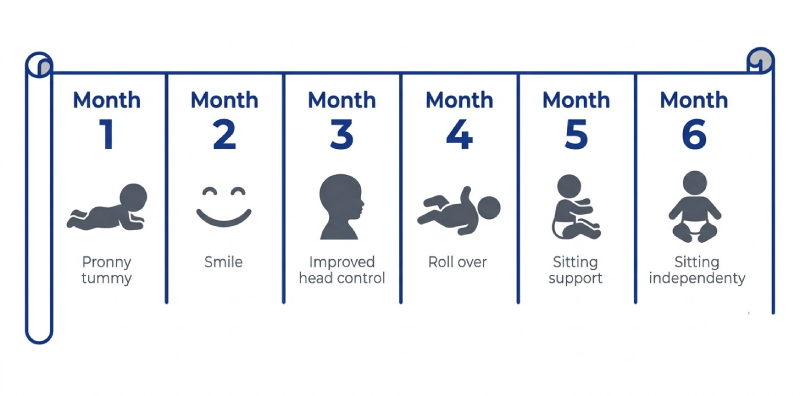
Developmental milestones: 0–6 months
1 month: Lifts head briefly during tummy time; startles to sound (Moro reflex); focuses on objects 20–30 cm away
2 months: Social smile (first smile in response to your face); tracks a slowly moving object with eyes; coos and makes vowel sounds
3 months: Holds head steady when upright; reaches toward objects; begins to laugh aloud; recognises familiar faces
4 months: Rolls from front to back; grasps objects placed in hand; babbles consonant sounds; pushes up on arms during tummy time
5 months: Sits with support; transfers objects from one hand to the other; responds to own name; imitates some sounds
6 months: Sits briefly without support; bears weight on legs when held standing; stranger awareness begins; responds to own name consistently
You do not need to test your baby on these skills. Simply playing with them, doing tummy time daily, and talking to them provides everything needed for normal development. These milestones are observable through everyday interaction.
Red Flags: When to Mention Something to Your Pediatrician
Milestones are ranges, not deadlines. One missed milestone in an otherwise developing baby rarely indicates a problem. That said, some observations are worth raising at your next visit — or sooner if you are concerned.
By 2 months: Not smiling socially; not tracking a slowly moving object with both eyes; not reacting to loud sounds
By 4 months: Not reaching for or batting at objects; no babbling or vowel sounds; head lags completely when pulled to sit (no neck control developing)
By 6 months: Not rolling in either direction; not bearing any weight on legs when supported standing; not responding to own name or to familiar voices
The most important thing to remember: early intervention is always better than waiting. If you notice something, log it and mention it at the next visit. Your pediatrician would far rather hear about a concern that turns out to be nothing than miss something that needed attention.
Growth Milestones: Weight, Length, and Head Circumference
Growth is one of the most reassuring indicators that a baby is healthy. Pediatricians measure weight, length, and head circumference at every well-baby visit and plot them on a growth chart. Understanding what these numbers mean takes some of the anxiety out of the process.
Typical growth rates in the first 6 months
Weight (0–3 months): 150–200 g per week
Weight (3–6 months): 100–150 g per week
Length: Approximately 25 cm gain in the first year
Head circumference: Measured at every well-baby visit; reflects brain growth
Percentiles describe where your baby sits relative to other babies of the same age and sex — they do not describe whether your baby is healthy. A baby consistently on the 10th percentile is doing exactly what that baby should be doing. What matters is consistency: a baby who drops from the 60th to the 20th percentile over a few months is more concerning than one who has always been at the 20th. For a full explanation, see our guide to baby growth charts.
How Tracking Data Helps at Pediatrician Visits
The most useful thing you can bring to a well-baby visit is a 3-day log of feeds, diapers, and sleep totals. Pediatricians ask the same questions at every appointment — and when you have the numbers in front of you, the visit becomes a conversation about trends rather than an exercise in trying to reconstruct the past week from memory.
Common questions you will be able to answer confidently with a log:
"How many wet diapers per day?" — The answer should be 6 or more from day 5 onward.
"How many times is your baby feeding per day?"— Newborns: 8–12. At 3 months: 6–8.
"How much is your baby taking per feed?" — For formula: you know exactly. For breastfeeding: duration and frequency give an indirect picture.
"How many hours is your baby sleeping?" — Total daily sleep across all naps and overnight.
For a full list of what to expect and prepare for at each checkup, see our pediatrician visit checklist.
Track Every Milestone in BabyJot
BabyJot logs feeds, diapers, sleep, growth measurements, and health notes automatically — so everything you need for the next pediatrician visit is already recorded. No paper notebook required.
Latest Articles

First Week With a Newborn: What No One Tells You

Newborn Sleep Patterns: What to Expect Week by Week

Breastfeeding vs. Formula: A Practical Guide for New Parents

Newborn Jaundice: What Parents Need to Know

Understanding Baby Growth Charts: Percentiles Explained

Baby Sleep Regression: Ages, Signs, and What Actually Helps

Safe Sleep for Babies: AAP Guidelines Every Parent Should Know

Baby Nap Schedule by Age: How Many Naps and How Long

Pumping Breast Milk: Schedule, Storage Guidelines, and Tips

Starting Solid Foods: Signs of Readiness and First Foods to Try

How to Prepare for a Pediatrician Visit: What Data to Bring

How Much Should a Newborn Eat? Feeding Amounts by Age
Baby Diaper Guide: What's Normal and When to Worry
