How Much Should a Newborn Eat? Feeding Amounts by Age

Newborn Stomach Size and Why Feeds Are So Frequent
One of the most useful pieces of knowledge for any new parent is understanding just how small a newborn's stomach is at birth — and how rapidly it grows in the first week. This single fact explains why 8–12 feeds per day is not only normal but biologically necessary, and why it is impossible for a newborn to "go longer between feeds" by simply trying harder.
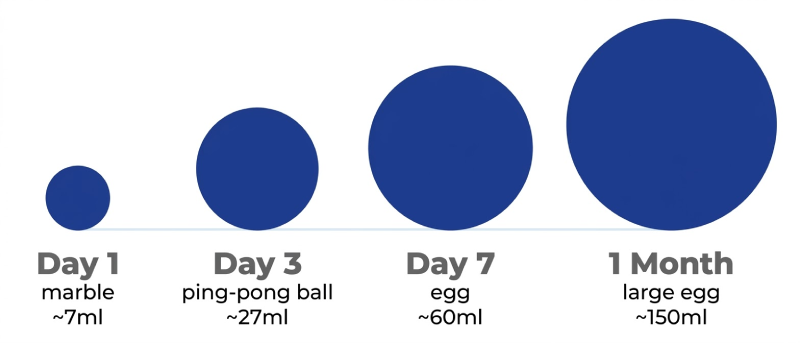
Newborn stomach capacity in week one:
Day 1: ~5–7 ml (size of a marble)
Day 3: ~22–27 ml (size of a ping-pong ball)
Day 7: ~45–60 ml (size of an egg)
1 month: ~80–150 ml (size of a large egg)
On day one, a newborn's stomach holds roughly a teaspoon of fluid — 5 to 7 milliliters. This is precisely why colostrum is produced in such small amounts: the body is perfectly matched to the baby's capacity. Colostrum is thick, concentrated, and packed with antibodies and immune factors. Volume is not the point at this stage; quality and frequency are.
By day three, the stomach has expanded to roughly 22–27 ml — the size of a ping-pong ball. This is also when mature milk typically begins to come in for breastfeeding mothers. By day seven, capacity has grown to around 45–60 ml, the size of an egg. The rapid growth of stomach capacity in week one mirrors the rapid increase in feeding volume that both breastfeeding and formula-feeding parents will observe.
The other reason feeds are frequent is digestion speed. Breast milk empties from the stomach in approximately 1.5–2 hours; formula takes 2–3 hours. Combined with a small stomach capacity, the result is that a newborn becomes hungry again very quickly after each feed. This is not hunger caused by insufficient milk — it is the natural rhythm of a tiny, rapidly growing digestive system. Expecting a newborn to go 4–5 hours between feeds in the first weeks is not physiologically realistic.
Breastfeeding: How Much and How Often
One of the most anxiety-producing aspects of breastfeeding is that you cannot see how much milk the baby is transferring. Unlike formula feeding, where the amount in the bottle is measurable, breastfeeding requires using indirect indicators to assess adequate intake — and these indicators are reliable when you know what to look for.
The AAP recommends breastfeeding 8–12 times per 24 hours in the newborn period, with sessions typically lasting 10 to 45 minutes depending on the baby's efficiency and the feeding. "Both sides or one side" is less important than whether the baby has transferred milk effectively — signaled by active swallowing during the feed, a breast that feels softer after the feed, and a baby who unlatches and seems settled rather than rooting immediately.
Breastfeeding frequency by age:
Newborn (0–2 wks): 8–12 feeds/24 hrs · every 1.5–3 hrs
1 month: 7–9 feeds/24 hrs · every 2–3 hrs
2 months: 6–8 feeds/24 hrs · every 3 hrs
3 months: 5–7 feeds/24 hrs · every 3–4 hrs
The most reliable signs of adequate breastfeeding intake are diaper output and weight gain. After day 4, a breastfed baby who is getting enough will produce 6 or more wet diapers per day, with urine that is pale yellow to clear. Yellow, seedy stools — often described as mustard-colored — should appear by day 4–5 and will be frequent in the early weeks (3–10 or more per day is normal for a breastfed newborn). Weight should return to birth weight by 10–14 days after the initial 5–10% loss.
Cluster feeding — periods of very frequent nursing, often in the evening, where a baby seems to feed continuously for 2–4 hours — is a normal developmental pattern and not a sign of low supply. For breastfeeding mothers, cluster feeding is actually the mechanism that drives supply increases: frequent milk removal signals the body to produce more. It is exhausting, but it is self-limiting and typically resolves within a few days as the baby's needs are met. For a detailed comparison of feeding options, see our guide to breastfeeding vs. formula.
Formula Feeding: Amounts by Age
Formula feeding gives parents the advantage of knowing exactly how much their baby consumed at each feed. This precision makes it easier to track daily intake and reassures caregivers who are worried about whether the baby is getting enough. The trade-off is that formula-fed babies may be slightly more prone to overfeeding if encouraged to finish every bottle regardless of hunger cues — always follow the baby's lead and stop when they show satiety signs such as turning away, slowing the suck, or becoming distracted.
Formula amounts by age:
Newborn: 45–90 ml (1.5–3 oz) per feed · every 2–3 hrs · 8–12 feeds/day
1 month: 90–120 ml (3–4 oz) per feed · every 3–4 hrs · 6–8 feeds/day
2 months: 120–150 ml (4–5 oz) per feed · every 4 hrs · 5–6 feeds/day
3 months: 150–180 ml (5–6 oz) per feed · every 4–5 hrs · 4–5 feeds/day
A useful rule of thumb for formula intake is approximately 150 ml per kilogram of body weight per day in the first 3–4 months. A 4 kg (roughly 9 lb) baby would therefore need around 600 ml of formula spread across the day's feeds. This is a guide, not a rigid target — weight gain and diaper output remain the most reliable indicators that intake is appropriate.
Total daily formula volume should not exceed approximately 900–1000 ml per day in the first 4 months. If your baby consistently seems hungry beyond these amounts, discuss it with your pediatrician rather than simply increasing volume — there may be other factors at play, including feeding pacing, nipple flow rate, or early signs of a growth spurt.
Growth Spurts: When Appetite Suddenly Jumps
Growth spurts are periods of accelerated physical and neurological development during which babies feed significantly more than their recent baseline — often for 2 to 3 days at a stretch before returning to their previous pattern. They are among the most common sources of worry for new parents, because a baby who suddenly seems insatiably hungry often looks like a baby who is not getting enough. In most cases, the opposite is true: the baby is growing, and appetite is rising to meet that demand.
Common growth spurt windows occur at approximately 3 weeks, 6 weeks, 3 months, and 6 months — though individual babies vary considerably. During a growth spurt, breastfed babies may nurse every 1–1.5 hours for a day or two. This is not a sign of low supply; it is the mechanism by which supply increases. More frequent nursing in response to demand is exactly what the body needs to upregulate milk production.
For formula-fed babies, a growth spurt may mean adding one extra feed per day during the spurt or increasing the volume of individual feeds slightly. Watch your baby's hunger cues and satiety signals rather than a fixed schedule during this period. Once the spurt passes — usually within 2–5 days — appetite typically returns to the pre-spurt pattern.
Growth spurts can also coincide with fussier behavior, shorter naps, and more frequent night waking. This combination of increased hunger and disrupted sleep can feel relentless, but it is temporary. Keeping a feeding log during growth spurts makes it easier to identify the pattern and reassure yourself that the frequency surge is time-limited.
Signs Your Baby Is Getting Enough
Knowing whether your baby is adequately fed is one of the most important questions of the newborn period. Fortunately, the body provides reliable external indicators when intake is sufficient — and equally clear signals when it is not.
Positive signs of adequate intake include: 6 or more wet diapers per day after day 5, with urine that is pale yellow to clear; a baby who seems content and not rooting immediately after feeds; and weight gain of approximately 150–200 grams (5–7 oz) per week in the first 3 months. Breastfed babies should have returned to their birth weight by days 10–14; formula-fed babies typically regain birth weight by 7–10 days.
Signs to discuss with your pediatrician:
Fewer than 6 wet diapers/day after day 5
Consistently crying after feeds despite appearing to have fed
Weight loss greater than 10% of birth weight
Not regaining birth weight by day 14
Dark, concentrated urine (orange or brick-red colored)
It is important to distinguish between a baby who is feeding frequently because they are genuinely hungry and a baby who is feeding frequently for comfort, overstimulation, or developmental reasons. Both are normal, and both are fine to respond to. The warning signs listed above are about output and weight — the objective measures — rather than feeding frequency alone.
To understand how your baby's weight gain compares to standard growth curves, see our guide to baby growth charts.
When to Move to Solid Foods
The AAP recommends introducing solid foods at around 6 months of age — not before 4 months, and ideally not later than 7 months. This guidance is based on both developmental readiness and digestive maturity. Before 4 months, the digestive system is not yet ready to process foods other than breast milk or formula, and introducing solids too early is associated with increased allergy risk and digestive discomfort.
Some babies show developmental readiness signs slightly before 6 months, and parents often ask whether this means they can start earlier. Individual signs of readiness include: the ability to sit with minimal support (not just propped up), loss of the tongue-thrust reflex (the automatic pushing-out of food placed in the mouth), and showing clear interest in food — watching intently when others eat, reaching toward food, or opening the mouth when a spoon approaches. All three signs together, after 4 months, suggest the baby may be ready; no single sign on its own is sufficient.
Starting solids does not mean reducing milk feeds significantly at first. In the early weeks of solid food introduction, solids are about exploration, texture experience, and developing motor skills — not about caloric replacement. Breast milk or formula remains the primary nutrition source through the first year. For a full guide to this transition, see our article on starting solid foods.
Log Every Feed With BabyJot
Feeding patterns are nearly impossible to track accurately from memory when you are sleep-deprived and feeding 8–12 times per day. Logging each feed — including the time, duration or volume, and which breast if nursing — takes seconds and gives you a complete picture of your baby's daily intake that no amount of guessing can replicate.
BabyJot displays daily feed totals and feeding intervals so you can immediately see whether your baby is feeding frequently enough, how the interval pattern is changing, and whether volume is on track for their age. No account needed — start logging now, directly in your browser.
Latest Articles

First Week With a Newborn: What No One Tells You

Newborn Sleep Patterns: What to Expect Week by Week

Tracking Baby Milestones: What to Log and Why It Matters

Breastfeeding vs. Formula: A Practical Guide for New Parents

Newborn Jaundice: What Parents Need to Know

Understanding Baby Growth Charts: Percentiles Explained

Baby Sleep Regression: Ages, Signs, and What Actually Helps

Safe Sleep for Babies: AAP Guidelines Every Parent Should Know

Baby Nap Schedule by Age: How Many Naps and How Long

Pumping Breast Milk: Schedule, Storage Guidelines, and Tips

Starting Solid Foods: Signs of Readiness and First Foods to Try

How to Prepare for a Pediatrician Visit: What Data to Bring
Baby Diaper Guide: What's Normal and When to Worry
