Newborn Sleep Patterns: What to Expect Week by Week
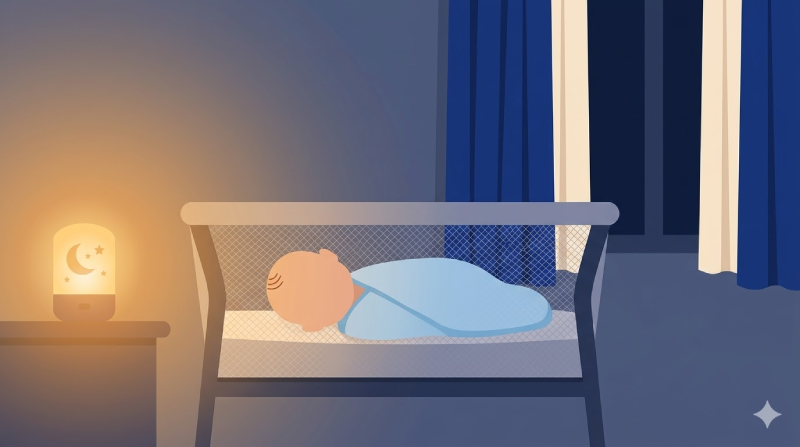
Why Newborns Sleep So Differently From Adults
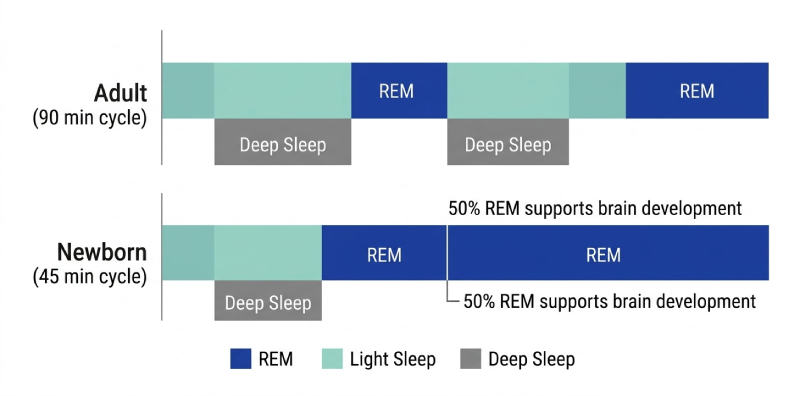
Adult sleep cycles last around 90 minutes and cycle through light sleep, deep sleep, and REM (rapid eye movement) sleep in a predictable pattern. Newborn sleep cycles are dramatically shorter — just 45 to 50 minutes — and they are structured very differently. Because a full cycle is so brief, newborns wake partially or fully between cycles far more often than adults do. This is not a flaw; it is biology working exactly as intended.
One of the most striking differences is how much time newborns spend in active (REM) sleep. Adults spend roughly 20–25% of their sleep in REM. Newborns spend approximately 50%. Active sleep is the stage in which the brain processes and consolidates new information, forms neural connections, and supports the explosive cognitive development happening in those first weeks. You may notice your newborn twitching, grimacing, making small sounds, or moving their eyes under their lids — all normal signs of active sleep.
Newborns also have no functioning circadian rhythm for the first 6–8 weeks of life. The circadian clock — the internal 24-hour timer that tells our bodies when to feel sleepy and when to feel alert — is regulated by melatonin, and newborns do not begin producing meaningful amounts of melatonin until around 3–4 months. Until then, sleep is distributed across the full 24-hour period with no preference for night over day. This is why keeping nighttime feeds calm and dim, and exposing your baby to natural light during the day, helps plant early cues even if results won't appear for weeks.
The American Academy of Pediatrics (AAP) recommends that newborns get 14–17 hours of total sleep per day, but this never arrives in one consolidated block. It is spread across many short periods throughout the day and night, punctuated by feeding windows. Understanding this biology makes it far easier to set realistic expectations — and to recognize that a baby who wakes every 2–3 hours is not doing anything wrong.
What to Expect Week by Week
Sleep does change across the first three months, but the changes are gradual and nonlinear. Some weeks feel like progress; others feel like regression. The broad trajectory is toward longer nighttime stretches and more defined daytime naps, but individual variation is wide.
Sleep by age — typical ranges:
Weeks 1–2: 16–18 hrs/day · 2–4 hr stretches · brief wake windows of 30–45 min
Weeks 3–4: 15–16 hrs/day · some babies begin stretching to 4–5 hrs at night
Weeks 5–8: 14–16 hrs/day · wake windows lengthen to 60–90 min · circadian rhythm beginning to form
Weeks 9–12: 14–15 hrs/day · first longer night stretches possible (5–6 hrs) · daytime naps more defined
Months 3–4: 14–15 hrs/day · 3–4 naps · first sleep regression risk at 4 months
In weeks 1 and 2, most of your baby's time is split between eating and sleeping, with wake windows so short that you may barely notice them. Your main job during this phase is to feed on demand and ensure safe sleep conditions every time the baby goes down — on their back, on a firm flat surface, in their own sleep space, with no loose bedding.
By weeks 3–4, some babies begin showing a loose preference for sleeping slightly longer at night compared to the day, though this is not universal. Feeding frequency remains high — 8–12 feeds per 24 hours — so night waking is expected and appropriate regardless of how long any single stretch lasts.
The weeks 5–8 window often brings a noticeable shift. Wake windows lengthen, which means your baby can tolerate more time awake between naps before becoming overtired. Overtiredness is one of the most common reasons newborns become difficult to settle — a baby who has been awake too long produces more cortisol, making it harder, not easier, to fall asleep. Watching the clock and your baby's cues together gives you the best chance of catching the sleep window at the right moment.
By weeks 9–12, many babies can achieve a 5–6 hour nighttime stretch at least occasionally. This is often when parents begin to feel like they can see light at the end of the tunnel. Daytime naps also begin to consolidate around this time, with naps at 3 months typically settling into a rough morning nap, afternoon nap, and a shorter late afternoon nap. For a structured approach to daytime sleep, see our guide on a baby nap schedule by age.
Reading Your Baby's Sleep Cues
One of the most practical skills you can develop in the newborn phase is recognizing sleep cues early — the subtle signals your baby sends before they tip into overtiredness. Early cues are calm and easy to miss; late cues mean the window has already passed and settling will be harder.
Early sleep cues to watch for include: slowing movements and becoming less interested in the environment, a fixed or glassy gaze (staring at nothing in particular), yawning once or twice, and light eye rubbing. At this stage, your baby is telling you they are approaching the edge of their wake window. Responding now — dimming lights, reducing stimulation, starting a brief pre-sleep routine — gives you the best chance of a smooth settle.
Late cues include fussing, crying, arching the back, and becoming difficult to hold calmly. At this point the baby is overtired and has entered a stress-hormone loop that makes sleep harder to initiate. It does not mean anything is wrong with your baby or your approach — it simply means the window was missed this time. Calm, consistent settling techniques will still work; they may just take longer.
Wake windows — the amount of time your baby can comfortably stay awake between sleeps — grow gradually across the first months. Newborns in weeks 1–2 can typically manage only 45–60 minutes of wakefulness before they need to sleep again. By 6 weeks that window extends to 60–90 minutes. By 3 months, most babies can handle around 90 minutes. These are averages; some babies run shorter and some longer, and factors like feeding, illness, and growth spurts all affect the window on any given day.
Common Sleep Myths for Newborns
Newborn sleep is surrounded by well-meaning advice, much of which is either outdated, oversimplified, or flat-out wrong. Knowing which beliefs to discard can save a great deal of frustration.
"Keep baby awake longer during the day and they'll sleep better at night." This is one of the most persistent myths — and the opposite of what the evidence shows. Overtired babies produce elevated cortisol, which acts as a stimulant and makes falling asleep harder and maintaining sleep more difficult. Well-rested babies sleep better. Adequate daytime sleep protects nighttime sleep, not the other way around.
"Newborns should be able to sleep through the night." A newborn's stomach holds very little — roughly 45–60 ml by the end of week one — and breast milk digests in 1.5–2 hours, formula in 2–3 hours. Biologically, a newborn cannot go 8 hours without a feed. Night waking to feed is not a behavioral problem; it is appropriate, normal, and important for healthy weight gain. Most pediatricians consider 5 hours a "long stretch" before 3 months; sleeping through 8+ hours typically does not happen until 4–6 months or later, and many healthy babies take longer.
"Cluster feeding means your milk supply is low." Cluster feeding — when a baby feeds very frequently for several hours, typically in the evening — is a completely normal developmental behavior. It is not a sign that the baby is not getting enough, nor a sign that supply is failing. For breastfeeding mothers, cluster feeding is actually the mechanism the body uses to increase supply: the more frequently milk is removed, the more the body produces. It is exhausting, but it is the system working correctly.
"You can spoil a newborn by responding to every cry." You cannot. The AAP is explicit on this point: consistently and promptly responding to an infant's cries builds secure attachment and does not create long-term dependence. Newborns cry because they have a need — hunger, discomfort, overstimulation, or the need for closeness. Meeting those needs reliably in the first months supports emotional development and, ultimately, produces babies who are more easily settled over time.
Tracking Sleep to Spot Patterns
One of the most underestimated challenges of the newborn phase is that sleep deprivation makes memory unreliable. You will genuinely not remember whether your baby's last nap was 45 minutes or 2 hours, or whether they settled easily or required 20 minutes of patting. This is not a personal failing — it is a predictable consequence of fragmented sleep across weeks. Logging sleep as it happens solves the problem entirely.
What is worth logging: the time sleep starts, the time sleep ends, and optionally whether the baby settled easily or with difficulty. Over a few days this information reveals your baby's natural rhythms — the times they tend to nap, the lengths of naps that seem most restorative, and whether night stretches are gradually getting longer. None of this is apparent from memory alone.
BabyJot's sleep matrix chart displays seven days of sleep data in a color-coded grid, showing every sleep period as a block across the 24-hour day. At a glance you can see whether sleep is consolidating, whether naps are shortening or lengthening, and whether there are consistent patterns forming at the same times each day. This kind of visualization is something no notebook or mental tally can provide.
The data you collect also feeds directly into pediatrician conversations. At the 2-week, 1-month, and 2-month well visits, your pediatrician will ask how the baby is sleeping. Being able to say "she's been averaging 15 hours per day, with one 4-hour stretch most nights, and naps are running 45–60 minutes" is far more useful than "I don't know, it's a blur." It also reassures you that development is on track — or flags early if something unusual is happening.
When to Talk to Your Pediatrician About Sleep
Most newborn sleep variation falls within a wide range of normal, and the single most important thing you can do for your baby's sleep at this stage is ensure safe sleep every time — back to sleep, on a firm flat surface, in their own space, every nap and every night. That said, there are specific situations where a conversation with your pediatrician is warranted.
In babies under 2 months, sleeping more than 5 consecutive hours without waking to feed is worth noting at the next visit or by phone if it happens regularly. Very young babies who are sleeping extremely long stretches without feeding may not be getting adequate nutrition, particularly if weight gain is not on track. If your baby is under 2 weeks old, your provider may recommend waking to feed if stretches exceed 4 hours.
At any age, contact your pediatrician if your baby is consistently difficult to rouse from sleep, seems lethargic or unusually unresponsive when awake, is not gaining weight appropriately, or shows any signs of respiratory difficulty during sleep such as pausing, gasping, or labored breathing. These are not common, but they are important to identify early.
Start Tracking With BabyJot
Sleep patterns reveal themselves over days and weeks, not hours. The best thing you can do right now is start logging — even if your baby is only a few days old. Every data point you collect makes the picture clearer and helps you understand whether the changes you're seeing represent genuine progress.
BabyJot lets you log sleep with a single tap, view your baby's full 7-day sleep matrix, and spot patterns you would never catch from memory alone. It runs entirely in your browser — no account, no signup, no data leaving your device.
Latest Articles

First Week With a Newborn: What No One Tells You

Tracking Baby Milestones: What to Log and Why It Matters

Breastfeeding vs. Formula: A Practical Guide for New Parents

Newborn Jaundice: What Parents Need to Know

Understanding Baby Growth Charts: Percentiles Explained
Baby Sleep Regression: Ages, Signs, and What Actually Helps

Safe Sleep for Babies: AAP Guidelines Every Parent Should Know
Baby Nap Schedule by Age: How Many Naps and How Long
Pumping Breast Milk: Schedule, Storage Guidelines, and Tips

Starting Solid Foods: Signs of Readiness and First Foods to Try

How to Prepare for a Pediatrician Visit: What Data to Bring

How Much Should a Newborn Eat? Feeding Amounts by Age
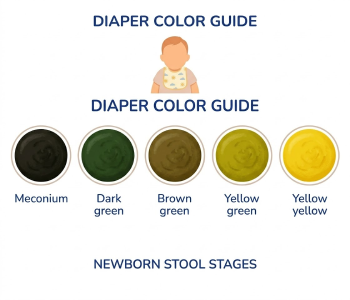
Baby Diaper Guide: What's Normal and When to Worry
