Pumping Breast Milk: Schedule, Storage Guidelines, and Tips
When and Why to Start Pumping
There is no single right reason to pump, and the decision is shaped by a combination of practical needs, feeding goals, and circumstances. The most common reason is building a freezer stash — a supply of stored milk that allows a partner to cover night feeds, prepares for a return to work, or provides flexibility if the nursing parent needs to be away. Even a modest reserve of 50–100 oz provides meaningful peace of mind.
Exclusive pumping — pumping instead of nursing for all or most feeds — is chosen by parents whose babies have difficulty latching (due to tongue tie, prematurity, or anatomical factors), by parents of NICU babies who cannot yet breastfeed directly, and by parents who prefer it for personal reasons. Exclusive pumping requires a structured schedule that mimics the frequency of direct feeding to maintain supply, and it is entirely possible to provide full breast milk nutrition this way.
Pumping after nursing feeds is a technique used to increase supply by sending an additional demand signal to the body. Milk production is governed almost entirely by how frequently and completely milk is removed from the breast: the more removal, the more the body produces. Pumping for 10–15 minutes after a feed — even if very little comes out — registers as additional demand and can meaningfully increase output over 3–5 days.
Timing matters: unless there is a NICU situation or an identified supply problem, most lactation consultants recommend waiting until breastfeeding is well established — typically 3–4 weeks — before introducing a pump. Starting earlier can stimulate oversupply, which brings its own complications including engorgement, blocked ducts, and discomfort. For a broader discussion of feeding decisions, see breastfeeding vs. formula.
Pumping Schedule for Exclusively Pumping Mothers
An exclusive pumping schedule needs to match the frequency of a newborn's feeding pattern closely enough to establish and maintain full supply. In the early weeks, that means 8–10 pumping sessions across 24 hours, with sessions spaced roughly every 2–3 hours. This includes at least one overnight session — ideally between midnight and 5 am, when prolactin (the hormone that drives milk production) peaks. Skipping the overnight session early on is one of the most common causes of gradually declining supply.
Each session should run for 15–20 minutes, or for about 5 minutes after the flow slows to drops after let-down. Running much longer does not significantly increase output and adds fatigue. Using a double electric pump — pumping both sides simultaneously — cuts session time in half and has been shown to increase output by approximately 18% compared to single pumping, due to the simultaneous let-down stimulation on both sides.
Exclusive pumping session frequency by stage
Weeks 1–2: 8–10 sessions/day · every 2–3 hrs · include overnight session
Weeks 3–8: 7–8 sessions/day · begin stretching one overnight gap to 4–5 hrs once supply is established
3–6 months: 6–7 sessions/day · most mothers drop to one overnight session or none if supply is stable
6+ months: 5–6 sessions/day · sessions can be reduced gradually as solids begin supplementing nutrition
Session frequency reductions should be made one session at a time, over several days, to allow the body to adjust gradually. Dropping multiple sessions at once risks a supply dip that can be difficult to reverse.
How Much Output to Expect
Output in the first days is almost nothing — and that is exactly right. In the first 1–3 days, the body produces colostrum: a thick, concentrated fluid that is available in small volumes (5–10 ml per session is normal and entirely adequate for a newborn's stomach, which holds roughly 5–7 ml at birth). Colostrum is exceptionally nutrient-dense and rich in antibodies; its low volume is not a supply problem.
Around days 3–5, mature milk comes in and output increases rapidly and visibly. Many mothers are surprised by how quickly the change happens. By weeks 2–6, average output for a double pump session typically runs 25–35 ml per breast, though variation is enormous — some mothers pump 10 ml per side and some pump 80 ml per side, and neither figure tells you anything meaningful about the quality of the milk or the health of the baby.
The benchmark for full supply for an exclusively pumping mother is approximately 750–950 ml (25–32 oz) per day by week 6. Reaching this level by that point indicates a well-established supply that can support a growing baby. Output below this level at 6 weeks is worth discussing with a lactation consultant, who can review pump settings, flange fit, session technique, and other factors before concluding that supply is genuinely low.
For context on how pumped volumes relate to what a baby needs at each age, see our guide on how much a newborn should eat.
Breast Milk Storage Guidelines
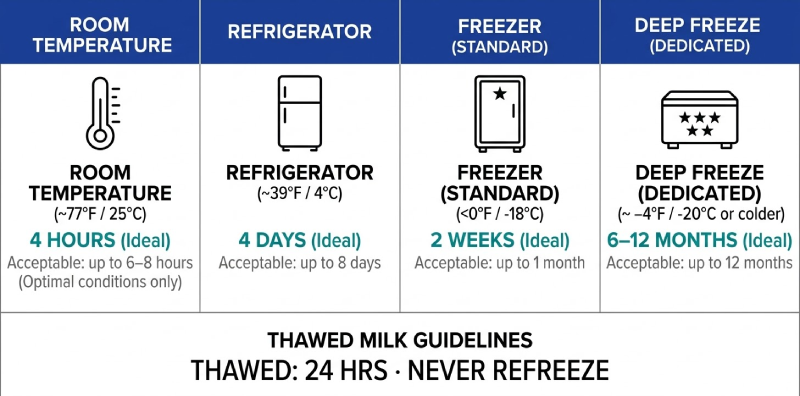
Safe storage times for breast milk are well-established by the CDC and AAP, and following them protects the milk's nutritional and immune properties. The general rule is: the colder the storage, the longer the milk keeps. When in doubt, use the shorter "ideal" time rather than pushing to the maximum acceptable limit.
Breast milk storage times — CDC/AAP guidelines
Room temperature (<25°C / 77°F): 4 hours ideal · up to 6 hours acceptable in very clean conditions
Refrigerator (4°C / 39°F): 4 days ideal · up to 5 days acceptable in a very clean, back-of-fridge location
Freezer compartment (−15°C / 5°F): up to 2 weeks · shared door unit
Deep freeze (−18°C / 0°F or colder): 6–12 months · best quality within 6 months
Previously frozen, thawed in fridge: use within 24 hours · never refreeze thawed milk
These times assume milk expressed under clean conditions and stored promptly. If you are unsure whether milk is still good, the smell test is useful — fresh breast milk smells sweet and mild; milk that has turned smells sour. Some fresh breast milk has a naturally soapy smell due to an enzyme (lipase) that is harmless but may cause refusal; scalding the milk before storage inactivates the enzyme.
Safe Handling and Preparation
Store pumped milk in BPA-free storage bags designed for breast milk or in BPA-free hard-sided containers with secure lids. Regular plastic bags and bottle liners are not appropriate — they are not sealed well enough and may contain plasticizers not suitable for food storage. Fill bags to no more than 60–80 ml to avoid waste when thawing individual portions.
Label every bag or container with the date pumped and the volume. Use the oldest milk first — rotate your freezer stash the same way you would anything else in your freezer. This simple habit prevents milk from sitting at the back until it exceeds the 6-month quality window.
To thaw frozen milk, move it to the refrigerator the night before you need it, or place the sealed bag in a bowl of warm (not boiling) water for 10–20 minutes. Never thaw or heat breast milk in a microwave: microwaving creates hot spots that can burn a baby's mouth and destroys a significant portion of the milk's immune-protective antibodies. To warm refrigerated milk, place the container in warm water or use a bottle warmer set to a low temperature.
When mixing fresh milk with refrigerated milk before storage, chill the fresh milk in the refrigerator first for at least one hour before combining — adding warm fresh milk to cold stored milk can partially thaw and reactivate bacteria. Swirl to mix layers of fat rather than shaking vigorously, as aggressive shaking can damage the milk's protein structure.
Pumping Output Troubleshooting
Low output is rarely caused by inherently low supply — it is most often caused by a correctable equipment or technique problem. The single most commonly overlooked factor is flange size. The flange (the funnel-shaped cup that fits over the nipple) should allow the nipple to move freely in and out during pumping without the areola being pulled in. Most pumps ship with a 21 mm flange, but research suggests that the majority of women need 24–28 mm. Pumping with a flange that is too small creates pain, restricts milk flow, and can cause tissue damage over time. Sizing up by even 3 mm can increase output dramatically.
Other common contributors to lower-than-expected output: pump suction mode (cycling through letdown mode first, then expression mode — not jumping straight to maximum suction), dehydration (aim for at least 2–3 litres of fluid per day), stress (cortisol suppresses oxytocin, which triggers let-down), and infrequent sessions. A pump that is more than one year old or has been used heavily may also have a degraded motor that reduces suction efficiency.
A blocked duct presents as a firm, tender lump in the breast with localized pain, sometimes accompanied by a wedge-shaped red area on the skin. First-line management: apply a warm compress for 3–5 minutes before pumping, gently massage the lump toward the nipple during the session, and increase pumping frequency on that side. Most blocked ducts resolve within 24–48 hours. If pain worsens, fever develops, or the lump does not improve, contact your provider as mastitis (infection) may need treatment.
Oversupply — producing significantly more milk than the baby needs — sounds desirable but creates real problems including severe engorgement, frequent blocked ducts, and a fast let-down that causes the baby to gag and fuss at the breast. To reduce supply, eliminate pumping sessions one at a time, waiting 3–4 days between each reduction. Never stop all pumping abruptly — doing so risks severe engorgement and mastitis.
Track Pumping Sessions in BabyJot
Tracking pumped volumes by session and by day reveals patterns that are impossible to spot from memory: the time of day when output is consistently highest (usually the first morning session), the effect of missing an overnight session, and the gradual upward trend that confirms supply is building. This data is also invaluable when discussing output concerns with a lactation consultant.
BabyJot lets you log pumping sessions with time, duration, and volume per side, and view output trends over days and weeks. No account required, and your data stays entirely on your device.
Latest Articles

First Week With a Newborn: What No One Tells You

Newborn Sleep Patterns: What to Expect Week by Week
Tracking Baby Milestones: What to Log and Why It Matters

Breastfeeding vs. Formula: A Practical Guide for New Parents

Newborn Jaundice: What Parents Need to Know

Understanding Baby Growth Charts: Percentiles Explained

Baby Sleep Regression: Ages, Signs, and What Actually Helps

Safe Sleep for Babies: AAP Guidelines Every Parent Should Know
Baby Nap Schedule by Age: How Many Naps and How Long

Starting Solid Foods: Signs of Readiness and First Foods to Try

How to Prepare for a Pediatrician Visit: What Data to Bring

How Much Should a Newborn Eat? Feeding Amounts by Age
Baby Diaper Guide: What's Normal and When to Worry
