Baby Nap Schedule by Age: How Many Naps and How Long
Why Nap Schedules Change So Rapidly in the First Year
No other aspect of infant care shifts as frequently as daytime sleep. In the space of twelve months, most babies move from sleeping five or six times a day to sleeping just once. Each of those transitions is driven by genuine neurological development — the brain's ability to sustain wakefulness grows steadily as circuits mature, sleep pressure builds more slowly, and the circadian rhythm (which barely exists in the first weeks) gradually consolidates. Expecting a four-month schedule to still work at seven months is a reliable path to frustration.
One of the most important concepts in nap science is the overtired trap. When a baby stays awake past the point where their body is ready for sleep, cortisol — the stress hormone — is released to keep them alert. Once cortisol is elevated, settling becomes harder, not easier. The baby may seem wired or fussy rather than drowsy. Parents who interpret this as "not tired yet" and keep the baby up longer compound the problem. The result is a baby who eventually crashes from exhaustion but takes a shorter, lighter nap than they would have if put down at the right moment.
The mirror problem is under-tiredness: a baby put down before enough sleep pressure has built will fight the nap, take a long time to fall asleep, and often produce a very short sleep because the drive to sleep was not strong enough to carry them through a full cycle. This is why neither the overtired nor the undertired baby naps well. Finding the wake window sweet spot — the period when sleep pressure is high enough to settle quickly but cortisol has not yet kicked in — is the central skill of nap management.
Nap Schedule by Age
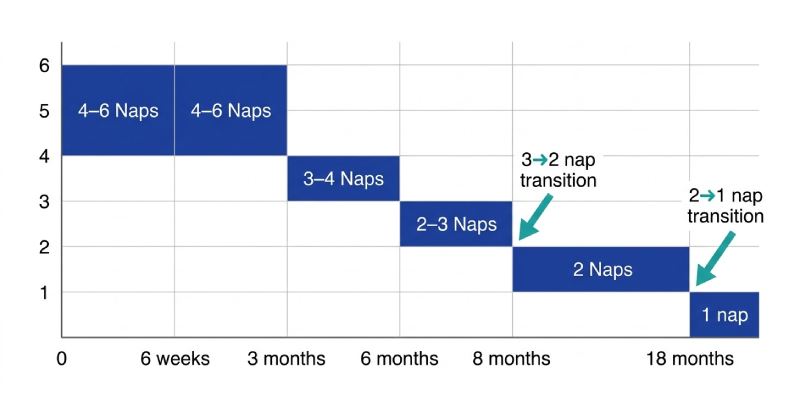
The table below shows typical nap needs across the first two years. These are population averages; your baby may run slightly earlier or later at each transition. What matters is watching the pattern in your own logs rather than forcing a schedule that belongs to a different developmental stage.
Nap schedule by age — typical ranges
Newborn (0–6 weeks): 4–6 naps/day · 20 min – 2 hrs each · wake windows 45–60 min
6–12 weeks: 4–5 naps/day · wake windows 60–90 min · naps begin to lengthen slightly
3–4 months: 3–4 naps/day · wake windows ~90 min · watch for the 4-month sleep regression
5–6 months: 3 naps/day · wake windows 1.5–2 hrs · naps more predictable in length
6–8 months: 2–3 naps/day · transitioning toward 2 naps · third nap often catnap of 20–30 min
8–18 months: 2 naps/day · wake windows 2.5–3.5 hrs · morning and afternoon naps established
18 months+: 1 nap/day · wake window 5–6 hrs · nap typically after lunch
Total daytime sleep also decreases across this span: newborns may accumulate 8–9 hours of daytime sleep across all their naps; by twelve months most babies nap a combined 2–3 hours. This is expected and healthy — the redistribution toward longer nighttime sleep is a sign of a maturing nervous system, not a problem to solve.
Wake Windows: The Concept That Changes Everything
A wake window is the amount of time a baby can comfortably stay awake between one sleep period and the next. It is not simply the time on the clock since they last woke up — it is the quality alert period: the stretch during which the baby is genuinely engaged, tolerating stimulation, and not yet producing the early signals that sleep is needed. Understanding wake windows is arguably the single most useful concept for navigating naps in the first year.
A wake window that is too short means the baby is not yet tired enough to nap well. You might observe: long struggle to fall asleep, a nap of only 20–30 minutes, or an early morning wake-up. Extending the wake window by 15 minutes can dramatically change nap quality in these cases.
A wake window that is too long produces the overtired scenario described above — cortisol, difficulty settling, and disrupted sleep. Signs include sudden fussiness after a period of happy wakefulness, yawning that has progressed to eye rubbing and crying, and arching the back when held.
The most reliable way to use wake windows is to watch your baby, not the clock. The clock gives you a starting frame; your baby's behaviour tells you where in that frame you actually are. Early signals to act on: a single yawn, a slow-down in movement, a glassy gaze fixed in the middle distance. These are the window opening. Waiting until crying has started means the window has closed.
Nap Transitions: Dropping from 3 to 2 to 1
Nap transitions are among the most disruptive phases of the first two years, largely because they are not clean switches. A baby does not wake up one day needing one fewer nap. Instead, there is a weeks- long period where the old schedule creates problems (late bedtime, fighting the last nap) but the new schedule creates different problems (overtiredness by bedtime, early morning waking). Both are temporary.
The 3-to-2 nap transition typically happens between 6 and 8 months. Signs it is time: the baby consistently fights the third nap or skips it entirely; bedtime becomes very late because the third nap pushed too close to night; morning and afternoon naps are lengthening and the third nap feels forced. During the transition, some days will need three naps (if the first two were short) and some will manage with two. This is normal. Aim for consistency within about 30 minutes of your target nap times rather than rigid clock-watching.
The 2-to-1 nap transition typically happens between 15 and 18 months, though some babies move earlier at 12–13 months and some as late as 20 months. Signs: the baby is fighting the second nap but still clearly needs the first; bedtime keeps getting later; morning nap is long and afternoon nap is nearly impossible. The transition period for 2-to-1 can take 4–8 weeks. An early lunch (around 11:00–11:30 am) followed by a post-lunch nap works well for most toddlers.
During any transition, a capped nap strategy can help: limit the first nap to 45–60 minutes to preserve sleep pressure for the second. Once the transition settles, natural nap lengths can resume.
Short Nappers: Why 30–45 Minute Naps Happen
The most common nap complaint in the first four months is the 30–45 minute nap — a baby who wakes at the end of one sleep cycle and cannot resettle into the next. This is not a feeding problem or a sign that something is wrong with your baby. It is a developmental limitation: the skill of transitioning between sleep cycles without fully waking (what sleep researchers call "self-settling") develops gradually, and most babies under 4–5 months simply do not yet have it reliably.
For newborns and young infants, being held through a nap — or rocking, feeding, or patting through the brief arousal at the 45- minute mark — is entirely developmentally appropriate. It does not create a habit that will last forever; it meets a genuine biological need at a stage when the baby does not yet have the capacity to bridge cycles independently.
From around 4–5 months, once the sleep architecture matures toward more adult-like cycles, many families find that gradual approaches to sleep skills — pause before responding, gentle settling techniques, consistent pre-nap routines — begin to help babies extend their naps. Before 4 months, most sleep training approaches are not developmentally appropriate and show limited effectiveness.
Logging Naps to Find the Pattern
Nap patterns are invisible without data. In the haze of the newborn and early infant phase, it is genuinely impossible to remember whether yesterday's first nap started at 9:15 or 10:00, or whether the nap that followed feeding was 40 minutes or 90. But those details are exactly what reveal whether your baby is running overtired or undertired, whether naps are consolidating, and whether you are hitting the wake window consistently or missing it by 20 minutes.
Manual logging of exact start and end times — even for just a few days — transforms the guesswork into a pattern. You will typically see clusters: a baby who tends to nap well at 9:30 am but fights the nap at 9:00 am has a wake window that needs a bit more time. A baby whose second nap used to be 90 minutes and is now consistently 30 minutes may be ready for a schedule shift.
The data also shows nap consolidation over weeks — the gradual lengthening of individual naps and the reduction in nap count that marks normal development. Seeing it in a log makes it far more reassuring than trying to remember whether "things feel better than last month."
BabyJot's sleep matrix displays seven days of sleep data as a color-coded grid across the 24-hour day. Nap blocks appear alongside night sleep, making it immediately visible whether naps are shortening, shifting earlier or later, or consolidating into fewer, longer periods. This kind of day-by-day comparison is something no mental note or paper log can provide. For a broader look at newborn sleep patterns in the first three months, including why newborns sleep so differently from older babies, see our dedicated guide.
Start Logging Naps in BabyJot
The nap schedule that works for your baby at any given age is the one built from your baby's actual data — not a generic chart. Logging start and end times for every nap gives you the raw material to find the wake windows that work, spot the transition before it fully arrives, and see progress even during the messy weeks in between.
BabyJot lets you log naps with a single tap, review your 7-day sleep matrix at a glance, and build the picture that turns nap chaos into a readable pattern. No account required, no data leaves your device.
Latest Articles

First Week With a Newborn: What No One Tells You

Newborn Sleep Patterns: What to Expect Week by Week

Tracking Baby Milestones: What to Log and Why It Matters

Breastfeeding vs. Formula: A Practical Guide for New Parents

Newborn Jaundice: What Parents Need to Know

Understanding Baby Growth Charts: Percentiles Explained

Baby Sleep Regression: Ages, Signs, and What Actually Helps

Safe Sleep for Babies: AAP Guidelines Every Parent Should Know
Pumping Breast Milk: Schedule, Storage Guidelines, and Tips

Starting Solid Foods: Signs of Readiness and First Foods to Try

How to Prepare for a Pediatrician Visit: What Data to Bring

How Much Should a Newborn Eat? Feeding Amounts by Age
Baby Diaper Guide: What's Normal and When to Worry
