Baby Diaper Guide: What's Normal and When to Worry

Diaper Output by Age: What's Normal
Diaper output is one of the most reliable external indicators of whether a newborn is adequately fed and hydrated. In the first days and weeks, parents and pediatricians use wet diaper counts and stool frequency as a primary metric for feeding adequacy — especially for breastfed babies, where it is impossible to directly measure milk transfer. Understanding the expected progression by day and age helps you know what to look for and when something is outside the normal range.
Diaper output — day by day in week one:
Day 1: 1+ wet diaper · 1 meconium stool (black, tarry)
Day 2: 2+ wet diapers · 1–2 stools (dark green, transitional)
Day 3: 3+ wet diapers · 1–2 stools (greenish-yellow)
Day 4–5: 4–6 wet diapers · 3–4 yellow seedy stools
Day 6+: 6+ wet diapers per day (ongoing benchmark)
The rule of "one wet diaper per day of age" in the first four days is a widely used clinical guideline: one wet diaper on day 1, two on day 2, and so on. By day 5–6 and beyond, the benchmark is 6 or more wet diapers per 24 hours, which should be maintained as the ongoing minimum through the newborn period. Falling below this threshold consistently is a reason to contact your pediatrician.
Stool frequency varies considerably between breastfed and formula-fed babies. Formula-fed newborns typically produce 1–4 stools per day. Breastfed newborns may produce anywhere from 3 to 10 or more stools per day in the first weeks — and after about 6 weeks, some breastfed babies shift to a pattern of one stool every 7–10 days. Both extremes are normal for breastfed babies after 6 weeks, provided the stool remains soft and yellow and the baby is gaining weight appropriately. For more context on the first week specifically, see our first week with a newborn guide.
Stool frequency by age and feed type:
0–6 weeks (breastfed): 3–10+ stools/day
6 weeks–3 months (breastfed): 1/day to 1 every 7–10 days — both normal
0–3 months (formula-fed): 1–4 stools/day
3–6 months (formula-fed): 1–3 stools/day
Urine: Color, Smell, and What It Means
Normal newborn urine is pale yellow to nearly clear and has minimal odor. In the first 24–48 hours of life, urine may be very concentrated and appear darker — this is normal because intake is low while colostrum volumes are minimal. As feeding volume increases from day 2 onward, urine should lighten progressively.
Concentrated, dark yellow, or orange-tinted urine after day 3 is a sign of inadequate fluid intake or dehydration. The most common cause is insufficient feeding — either feeding frequency that is too low or difficulty transferring milk during breastfeeding. If urine is consistently dark after day 3, contact your pediatrician, who may want to assess weight and feeding technique.
In the first 1–2 days of life, some newborns produce a pinkish or rust-colored stain in the diaper. This is typically caused by urate crystals — a harmless deposit that forms when urine is very concentrated. It is common in the first 48 hours and should resolve as feeding increases. If you see pink or rust-colored staining after day 2–3, mention it to your pediatrician, who may want to evaluate feeding and hydration status.
Cloudy urine or urine with a strong, unpleasant odor is not normal at any age and may indicate a urinary tract infection (UTI), which can occur in babies and young infants. UTIs in infants often present without the typical adult symptoms and may cause only subtle signs such as unexplained fussiness, poor feeding, or fever. Any consistently foul-smelling or cloudy urine warrants a same-day call to your pediatrician.
Stool Color Chart: From Meconium to Mustard
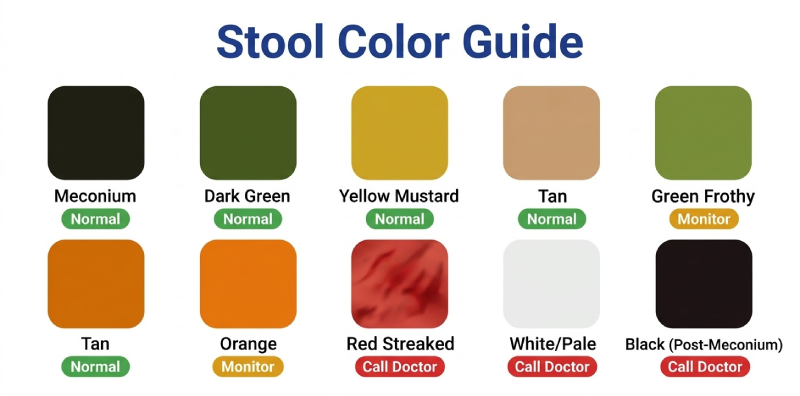
Stool color is one of the most information-rich signals your baby's diaper provides. Most colors fall within the wide range of normal; a few are specific warning signs that require prompt medical attention. The following chart covers the full spectrum you are likely to encounter.
Stool color guide:
Black / tar-like (meconium): Days 1–2 · Normal — sterile waste from the womb
Dark green: Days 2–3 · Normal — transitional stool as meconium clears
Yellow / seedy (breastfed): Day 4+ · Normal — mustard-yellow, loose, seedy texture
Tan / yellow (formula-fed): Normal — thicker and more formed than breastfed stools
Green and frothy: Possible foremilk/hindmilk imbalance or food sensitivity — mention to doctor if persistent
Orange: Normal variation, often seen in breastfed babies
Red streaks or blood: Call doctor · possible anal fissure, cow's milk protein allergy, or other cause
White / pale / chalky: Call doctor immediately · can indicate a liver or bile duct problem requiring urgent evaluation
Black after the meconium phase: Call doctor · may indicate bleeding in the upper GI tract
The two colors that always warrant immediate medical attention are white or very pale stools and black stools after the meconium phase has passed. White or chalky stools may indicate a problem with the liver or bile ducts — a condition called biliary atresia, which is rare but treatable if caught early and dangerous if missed. If you ever see consistently white or pale gray stools, call your pediatrician the same day. For context on newborn jaundice — which is related to bilirubin, the pigment that normally colors stools brown — see our newborn jaundice guide.
Green frothy stools can have several causes. In breastfed babies, they are sometimes associated with foremilk/hindmilk imbalance — when a baby is getting a higher proportion of lower-fat foremilk. This can happen if feeding sessions are very short, if switching breasts frequently, or if supply is very high. Ensuring your baby finishes one breast fully before switching often resolves the issue. Green frothy stools can also signal a food sensitivity in the mother (most commonly cow's milk protein), particularly if accompanied by blood streaks or significant fussiness.
Consistency: What Does Normal Look Like?
Stool consistency varies significantly between breastfed and formula-fed babies, and understanding the difference helps prevent unnecessary concern. Normal breastfed stools are loose to watery, often seedy or pasty, and yellow-mustard in color. They may look alarmingly liquid to new parents, but this is completely expected — breast milk is easily digested and leaves little residue.
Formula-fed stools are typically thicker, more formed, and tan to yellow-brown in color. They tend to have more odor than breastfed stools and are firmer in texture. The difference is significant enough that parents who switch from breastfeeding to formula often notice the change in consistency immediately.
Explosive, very watery stools that persist for more than 2 days — especially if accompanied by increased frequency beyond the baby's baseline — may indicate a gastrointestinal infection or a food allergy or sensitivity. Diarrhea in newborns and young infants can cause dehydration quickly. If watery stools are accompanied by fewer wet diapers, lethargy, or fever, contact your pediatrician promptly.
Hard, pellet-like stools that appear dry and are clearly difficult or painful for the baby to pass are a sign of constipation. This is rare in breastfed babies but more common in formula-fed babies, particularly when switching formulas, and very common when starting solid foods. Hard stools in a formula-fed baby may indicate the formula needs adjustment or that fluid intake needs to increase.
Constipation: Causes and What to Do
True constipation in a breastfed baby under 6 weeks is very uncommon. Breastfed babies can go days between stools — including up to 7–10 days — and as long as the eventual stool is soft and yellow and the baby is comfortable and not straining, this is normal. The frequency alone does not define constipation; consistency and comfort do.
Formula-fed babies are more prone to constipation, particularly during the newborn period or when transitioning between formulas. If your formula-fed baby is producing hard, dry stools and straining uncomfortably, a few approaches may help: ensure bottles are mixed to the correct water-to-powder ratio (over-concentrated formula is a common culprit), try a different formula brand under guidance from your pediatrician, and use gentle physical techniques such as bicycle leg movements and clockwise tummy massage to stimulate bowel activity.
Constipation becomes very common when starting solid foods at around 6 months. The digestive system is adapting to a completely new category of food, and harder stools are a predictable transition. Pureed prunes, pears, and peas are reliably effective at softening stools naturally. Adequate water intake (from breastfed or formula feeds, or small amounts of water for babies over 6 months) also helps.
Contact your pediatrician about constipation if: there is blood in the stool, the baby cries intensely during attempts to pass stool, the abdomen is hard and visibly distended, or the baby has not passed any stool for more than 5–7 days (formula-fed) and appears uncomfortable. Do not give laxatives, suppositories, or stool softeners to infants without specific medical guidance.
When to Call the Doctor
Most diaper findings in the newborn period are normal variation, and the color chart above covers the full spectrum. There are, however, a handful of signs that require a same-day call or an immediate visit to your pediatrician or emergency department:
White, pale, or chalky stools — always call your doctor the same day, regardless of other symptoms. This is one of the few diaper findings that can indicate a serious underlying problem requiring prompt evaluation.
Blood in the stool — red streaks or clearly bloody stools warrant a call. Most causes are minor (anal fissure, food sensitivity), but some require investigation, and the pediatrician needs to know.
No stools at all in the first 24 hours — the first meconium stool should appear within 24 hours of birth. If it does not, notify the nursing team before leaving the hospital.
Fewer than 6 wet diapers per day after day 5 — this suggests inadequate intake and needs prompt assessment of feeding.
Persistent watery diarrhea for more than 2 days — especially with fever, blood, or signs of dehydration (dry mouth, decreased alertness, no tears when crying).
For a full checklist of what to discuss and track at each well-baby visit, including diaper output milestones, see our pediatrician visit checklist.
Track Diapers With BabyJot
Diaper output patterns are nearly impossible to recall accurately after a sleepless night. Logging each diaper as it happens — with color, type (wet, stool, or both), and any notable observations like leakage or unusual color — takes seconds and gives you an accurate record that is genuinely useful at pediatrician visits.
When your pediatrician asks "how many wet diapers per day is she having?" you will have an exact answer rather than a guess. And if something is ever outside the normal range, your log makes it easy to identify when the change started — information that helps your care team quickly.
BabyJot includes a one-tap diaper logger with color and type options. Your data stays entirely on your device — no account required. Start logging today and have the numbers ready when it matters.
Latest Articles

First Week With a Newborn: What No One Tells You

Newborn Sleep Patterns: What to Expect Week by Week

Tracking Baby Milestones: What to Log and Why It Matters

Breastfeeding vs. Formula: A Practical Guide for New Parents

Newborn Jaundice: What Parents Need to Know

Understanding Baby Growth Charts: Percentiles Explained

Baby Sleep Regression: Ages, Signs, and What Actually Helps

Safe Sleep for Babies: AAP Guidelines Every Parent Should Know

Baby Nap Schedule by Age: How Many Naps and How Long

Pumping Breast Milk: Schedule, Storage Guidelines, and Tips

Starting Solid Foods: Signs of Readiness and First Foods to Try

How to Prepare for a Pediatrician Visit: What Data to Bring

How Much Should a Newborn Eat? Feeding Amounts by Age
