Safe Sleep for Babies: AAP Guidelines Every Parent Should Know
The ABCs of Safe Sleep
The American Academy of Pediatrics (AAP) published updated safe sleep guidelines in 2022, and the core message can be summarized in three letters: A, B, C.
A — Alone. Baby should sleep alone in their own sleep space, without other people, pets, or objects sharing the surface. No bed-sharing, no sleeping in an adult bed even for naps. Soft objects, loose bedding, and other people in the sleep space are all independent risk factors for sleep-related infant deaths.
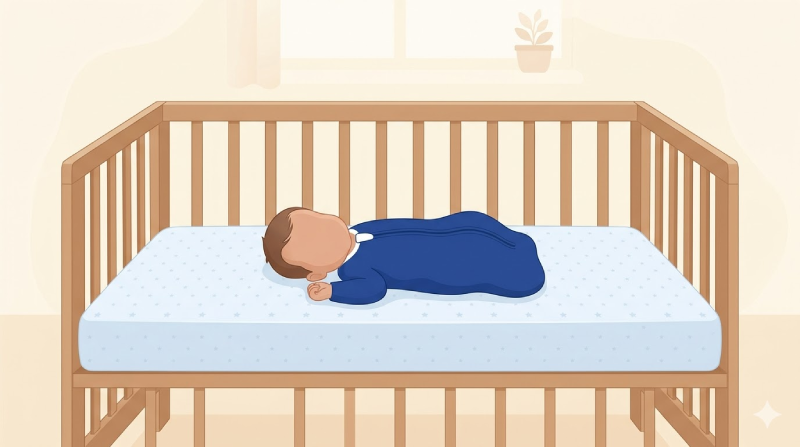
B — Back. Always place baby on their back for every sleep — every nap, every night — until their first birthday. Back sleeping reduces the risk of sudden infant death syndrome (SIDS) by approximately 50%, according to AAP data. Once a baby can roll from back to front independently and back again, you no longer need to reposition them if they roll during sleep — but always start them on their back.
C — Crib (or approved sleep surface). Baby should sleep on a firm, flat surface in a safety-approved crib, bassinet, or play yard with a tight-fitting sheet. No soft mattresses, no memory foam, no inclined surfaces. No pillows, positioners, bumper pads, or soft toys in the sleep space — ever.
These three principles underpin all of the more specific guidance below. When in doubt about any product or practice, returning to A-B-C gives you a reliable filter. To understand what sleep looks like in the early weeks before and after safe sleep habits are established, see our guide on newborn sleep patterns.
The Safe Sleep Environment Checklist
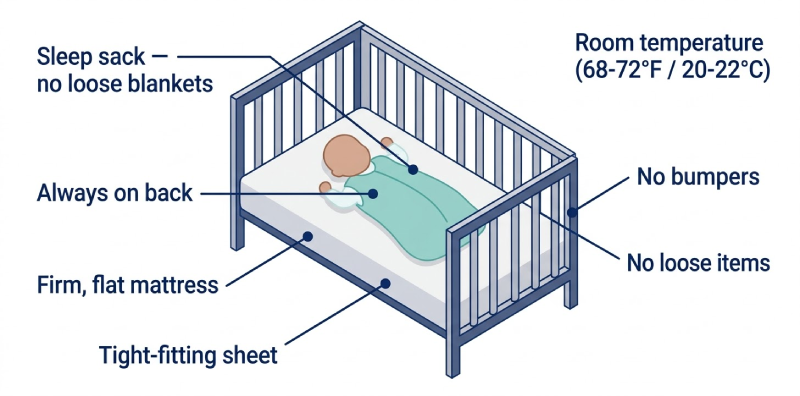
Safe sleep is about the complete environment, not just position. Every item in and around your baby's sleep space either reduces or increases risk. The checklist below reflects current AAP guidance.
Safe sleep environment checklist
Sleep surface: Firm, flat mattress with a tight-fitting sheet — no soft toppers, no memory foam
No loose items: No pillows, positioners, bumper pads, rolled blankets, or soft toys in the crib or bassinet at any time
Room temperature: 68–72°F (20–22°C) — dress baby in one layer more than an adult would wear comfortably
Sleepwear: Sleep sack or swaddle (arms free once rolling signs appear, typically from 8 weeks) — no loose blankets
No inclined sleep: Do not use inclined sleepers, car seats, bouncers, or swings for routine sleep
Smoke-free: No smoking near baby or in the home — thirdhand smoke on clothing and surfaces also raises SIDS risk
No overheating: Baby should not feel hot to the touch on their chest or back; sweating or flushed skin indicates too warm
Crib bumpers deserve specific mention because they are still widely sold and gifted despite being banned from sale in Canada and recommended against by the AAP. They do not prevent injury and have been associated with infant deaths from entrapment and suffocation. Remove them from any crib that has them, regardless of how they are marketed.
Room-Sharing vs. Bed-Sharing
The AAP recommends that babies share a room — but not a sleep surface — with a parent or caregiver for at least the first 6 months of life, and ideally for the first year. This is one of the most evidence-based recommendations in infant sleep safety: room-sharing (with the baby in their own separate sleep space) reduces the risk of SIDS by up to 50% compared to sleeping in a separate room.
Room-sharing makes night feeds easier, allows you to respond quickly to your baby's cues, and keeps you attuned to any changes in breathing or behavior during sleep. A bedside bassinet or crib that attaches to the adult bed height achieves room-sharing without any shared sleep surface.
Bed-sharing — where parent and infant share the same sleep surface — is a different matter. The AAP recommends against it due to the risk of entrapment, suffocation, and overlay, particularly when the sleep surface involves soft bedding, and when a parent is a smoker, has consumed alcohol, or has taken sedating medications. These factors compound the baseline risk significantly.
Some families choose to bed-share, and if that is the case, the evidence-informed approach involves: a firm mattress only (no soft toppers or pillows near the baby), no loose blankets over the baby, both parents sober and non-smoking, and positioning the baby away from the edge. The AAP acknowledges this reality while maintaining its recommendation against bed-sharing, particularly for babies under 4 months, preterm infants, and those with low birth weight, who carry the highest risk.
Swaddling: Safe Practice and When to Stop
Swaddling — wrapping baby snugly in a light blanket — reduces the Moro (startle) reflex that often wakes newborns and can help a baby feel more settled in the early weeks. When done correctly, it is safe and beneficial. When done incorrectly, it introduces risk.
Safe swaddling rules: always place a swaddled baby on their back — never on their side or stomach. The swaddle should be snug around the arms and torso but loose around the hips and legs. Tight swaddling around the legs and hips prevents the natural frog-leg position the hip joints need to develop properly and is a risk factor for hip dysplasia. Use a breathable fabric (muslin, cotton) and ensure the blanket cannot unravel and cover the face.
The most critical rule: stop swaddling as soon as your baby shows any sign of rolling. This typically happens somewhere between 8 and 12 weeks, but can happen earlier with some babies. A swaddled baby who rolls onto their stomach cannot use their arms to push their face away from the mattress — this is a suffocation risk. You do not need to wait until the baby rolls consistently; the first sign of attempted rolling is the signal to transition out.
The transition: moving directly from full swaddle to no swaddle is often disruptive. A gentler approach is to leave one arm free for several nights, then move to both arms free, then switch to a sleep sack. This gradual transition gives the baby time to adjust to the startle reflex without the abrupt change triggering significant sleep disruption. For guidance on sleep patterns during this transition period, see our article on newborn sleep patterns.
Pacifiers and Safe Sleep
Pacifier use at sleep time is one of the few practices associated with a reduced risk of SIDS, and the AAP recommends offering one at nap time and bedtime throughout the first year. The mechanism is not fully understood but may involve the sucking reflex maintaining arousal during sleep, making it harder to enter the very deep sleep state associated with SIDS.
If you are breastfeeding, the AAP suggests waiting until breastfeeding is well established — around 3 to 4 weeks — before introducing a pacifier, though more recent evidence suggests earlier introduction does not meaningfully affect breastfeeding outcomes for most babies.
Important pacifier safety notes: do not force it — if the baby rejects it, do not reinsert it after it falls out during sleep. Never attach the pacifier to a cord, clip, or stuffed animal that could become a strangulation or suffocation hazard in the sleep space. And plan to wean from pacifier use by 12 months to protect the developing dental arch and bite alignment, as recommended by the American Academy of Pediatric Dentistry.
Safe Sleep When Traveling or in Other Environments
Safe sleep guidelines apply everywhere the baby sleeps — not just at home. Consistency matters: a baby who sleeps safely at home can still face risks in unfamiliar environments where the safe sleep setup has not been maintained.
Travel cribs and pack-n-plays with their original firm, flat mattress pad are an acceptable sleep surface. Do not add extra padding or a separate mattress insert — the pad that came with the product is designed to meet safety standards; additional softness is a risk. Bring your own if you have concerns about the mattress quality at your destination.
Car seats, swings, and bouncers are not safe for routine sleep. These surfaces are inclined, and an infant's heavy head can fall forward in an inclined position and compromise the airway. Car seat use during actual car travel is necessary and safe when properly buckled and supervised; the risk arises from leaving a sleeping baby in a car seat after arriving at your destination. If your baby falls asleep in the car, transfer them to a flat surface as soon as safely possible.
Hotel and borrowed cribs should be checked for safety recalls before use. The Consumer Product Safety Commission (CPSC) maintains a searchable database of recalled products. If you are uncertain about the age or safety status of a crib you will be using, bring your own travel crib rather than taking the risk.
Grandparents and other caregivers may have raised children in an era of different recommendations — when stomach sleeping was advised, when bumper pads were considered protective, and when soft blankets in the crib were standard. Share safe sleep guidelines proactively and specifically, rather than assuming shared knowledge. A brief, matter-of-fact conversation before the first time a caregiver puts the baby down is far less awkward than discovering a safety issue after the fact. For a complete checklist to walk through with caregivers, our baby bath guide also covers broader infant safety practices worth reviewing together.
Log Every Sleep in BabyJot
Consistent sleep logging does more than track patterns — it creates an auditable record of when your baby slept and in what conditions. Notes in BabyJot can be used to log the sleep environment for each session: where the baby slept, position observed, and any relevant circumstances. This kind of documentation is especially useful when multiple caregivers are involved, ensuring everyone is aligned on safe sleep practices.
BabyJot lets you log every sleep session with a single tap and add notes at any time. Over days and weeks, the sleep matrix gives you a clear view of your baby's patterns — helping you spot whether naps and nighttime sleep are developing normally and giving you accurate data for every conversation with your pediatrician.
Latest Articles

First Week With a Newborn: What No One Tells You

Newborn Sleep Patterns: What to Expect Week by Week
Tracking Baby Milestones: What to Log and Why It Matters

Breastfeeding vs. Formula: A Practical Guide for New Parents

Newborn Jaundice: What Parents Need to Know

Understanding Baby Growth Charts: Percentiles Explained
Baby Sleep Regression: Ages, Signs, and What Actually Helps
Baby Nap Schedule by Age: How Many Naps and How Long
Pumping Breast Milk: Schedule, Storage Guidelines, and Tips

Starting Solid Foods: Signs of Readiness and First Foods to Try
How to Prepare for a Pediatrician Visit: What Data to Bring

How Much Should a Newborn Eat? Feeding Amounts by Age
Baby Diaper Guide: What's Normal and When to Worry
