Baby Sleep Regression: Ages, Signs, and What Actually Helps
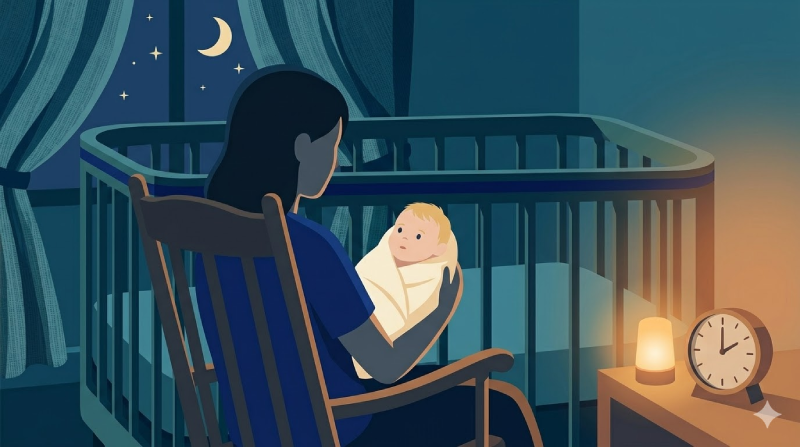
What Is a Sleep Regression?
A sleep regression is a temporary period — typically lasting 2 to 6 weeks — during which a baby who has been sleeping reasonably well starts waking more frequently, fighting naps, or taking much longer to settle. If you felt like sleep was improving and then abruptly fell apart, you have likely hit a regression.
The underlying cause is not behavioral or a sign that something has gone wrong. Sleep regressions are driven by developmental leaps: rapid brain growth, the acquisition of new motor skills, and an expanding awareness of the world. A baby who is learning to roll, sit, crawl, or walk is doing enormous cognitive and physical work, and that work disrupts sleep architecture in predictable ways.
Understanding this reframing is genuinely useful: your baby is not regressing — they are progressing. The disrupted sleep is a side-effect of development, not a problem to be fixed. It will pass. For broader context on how newborn sleep changes across the early months, see our guide to newborn sleep patterns.
The 4-Month Sleep Regression: The Big One
The 4-month regression is the most significant of all regressions, and it is worth understanding why. Before about 4 months of age, babies cycle between deep sleep and REM sleep in a relatively simple pattern, and they often fall back asleep easily between cycles without fully waking. Around 3–4 months, this changes permanently.
Infant sleep architecture matures to resemble the adult pattern: a progression through light sleep, deep sleep, and REM across a full cycle, with a period of lighter, more aroused sleep between cycles. Adults navigate this transition back to sleep automatically. Babies who have not yet learned to self-settle cannot — they wake fully at the end of each 45-minute cycle, realize their sleep conditions have changed (they fell asleep feeding or being held and now they're alone in a dark crib), and cry. One sleep cycle was 45 minutes. Suddenly every nap is 45 minutes and every night involves waking every 45–60 minutes.
This change is permanent — the sleep architecture does not revert. That is why the 4-month regression feels different from others: it is not just a temporary blip but a new normal that requires a new approach. The good news is that babies can learn to navigate these transitions independently with consistent support.
Signs of the 4-month regression: waking every 45–60 minutes through the night, previously reliable naps becoming short and catnap-like, increased fussiness and feeding demands, and difficulty settling at bedtime even when visibly tired. Duration is typically 2–6 weeks, though this varies.
What helps: establish a consistent and predictable bedtime routine (bath, feed, song, dark room — the same sequence every night creates a powerful sleep cue). Practice putting your baby down drowsy but awake during at least some sleep periods so they begin to develop the skill of falling asleep from a wakeful state. Respond consistently when they wake — whether you choose to soothe immediately or use a gradual approach, the consistency itself is what matters most.
Other Common Regressions
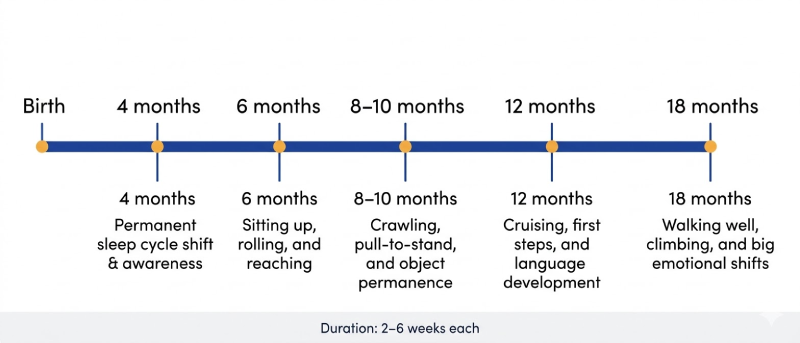
The 4-month regression is the most discussed, but it is not the only one. Developmental milestones continue to disrupt sleep throughout the first two years, with several other well-recognized regression windows.
Common sleep regression windows
4 months: Sleep architecture matures permanently · wake windows lengthen · Duration: 2–6 weeks · Key sign: waking every 45–60 min at night
6 months: Rolling, early sitting, teething begins, separation anxiety emerging · Duration: 1–3 weeks · Key sign: increased night waking after a settled period
8–10 months: Crawling, pulling to stand, intense separation anxiety · Duration: 2–4 weeks · Key sign: refusing to be put down, frequent waking with crying until parent appears
12 months: Walking, language explosion, natural transition from 2 naps to 1 nap · Duration: 2–4 weeks · Key sign: fighting the second nap, early morning waking
18 months: Second molars erupting, vocabulary explosion, asserting independence · Duration: 2–6 weeks · Key sign: bedtime resistance, calling out repeatedly after being put down
Not every baby experiences every regression, and the timing varies. Some babies sail through a developmental milestone without any sleep disruption; others are knocked flat for several weeks. Temperament, existing sleep habits, and environmental factors all play a role.
Is It a Sleep Regression or Something Else?
Not every sudden change in sleep is a regression. Before assuming you have hit a regression window, it is worth ruling out the following common causes of disrupted sleep:
Illness. A baby who is coming down with a cold, ear infection, or other illness will often show sleep disruption before other symptoms appear. Check temperature, observe for runny nose, pulling at ears, or unusual lethargy when awake. Illness-driven sleep disruption typically resolves within a few days once the baby recovers, which distinguishes it from a regression that lasts weeks.
Teething. Teething discomfort — characterized by drooling, gum swelling, cheek rubbing, and gnawing on objects — can disrupt sleep, but its effect is often overstated. Most teething pain is manageable during the day and causes brief rather than prolonged nighttime disruption. If disruption lasts more than a few days without other teething signs, another cause is more likely.
Growth spurt-driven hunger. A baby going through a growth spurt needs more calories, which means more frequent waking to feed. This is not a sleep regression — it is a feeding need. Responding by increasing feed frequency (rather than trying to stretch feeds) will resolve it within a few days. True growth-spurt hunger waking decreases naturally once the spurt passes.
Environmental disruption. Travel, a new room, a change in caregiver, or a disrupted schedule can all temporarily upset sleep. These disruptions typically resolve within a few days to a week once the baby re-acclimates.
The practical rule of thumb: if it resolves within a few days, it was illness, hunger, or disruption. If it lasts 2+ weeks and aligns with a known developmental window, it is most likely a regression.
What Actually Helps During a Regression
There is no intervention that eliminates a sleep regression. The developmental leap driving it has to run its course. But how you respond during a regression significantly affects how long it lasts and what sleep looks like on the other side.
Do not introduce new habits you will need to break later. The most common regression trap is bringing a baby who normally sleeps in their own space into the parental bed because it is the only thing that works at 3 a.m. If that is a long-term arrangement you want, that is a valid choice. If it is not, doing it during a regression means you will be re-training a more established habit afterward. This is not a judgment — it is practical information.
Maintain the existing routine even when it fails. The bedtime routine is a cue, not a guarantee. A familiar bath, feed, and dark-room sequence tells your baby's nervous system that sleep is coming, even on nights when getting to sleep still takes time. Abandoning the routine because "it doesn't work anymore" removes one of the most reliable sleep signals you have. Keep doing it.
Respond consistently. Whether you choose to soothe immediately, use a gradual settling approach, or something in between, the consistency of your response matters more than the specific method. Inconsistency — sometimes responding immediately, sometimes waiting, sometimes bringing the baby into bed, sometimes not — creates uncertainty that actually extends regressions by making it harder for the baby to predict what comes next.
Accept temporary increased feeding. Hunger is real during developmental leaps. A baby who is building new neural connections and new muscle groups is burning more energy. Temporarily increased nighttime feeds during a regression period are appropriate, not a step backward.
Rest when the baby rests. The most important thing for you during a regression is protecting your own capacity to respond consistently. An exhausted parent makes good decisions less well. The regression will end. The sleep debt you accumulate does not have to be permanent.
Using Sleep Logs to Navigate Regressions
One of the most disorienting aspects of a sleep regression is that it creates the feeling that sleep has completely fallen apart with no pattern at all. This feeling is almost never accurate, but the sleep deprivation that accompanies a regression makes it impossible to assess from memory alone.
Logging sleep during a regression serves three purposes. First, it shows you that there is still a pattern — naps are still happening at roughly predictable times, even if they are shorter. Second, it helps you distinguish a regression from illness or hunger: a regression typically affects night sleep more than daytime behavior, while illness tends to affect both. Third, and most importantly, it shows you when it is improving. Total daily sleep hours recovering toward the pre-regression baseline over a period of days is the earliest objective sign that the regression is passing — and that evidence is genuinely sustaining when you are running on little sleep.
For a structured approach to nap scheduling before and after regression periods, see our baby nap schedule by age guide, which covers wake windows and nap counts from newborn through toddlerhood.
BabyJot's sleep matrix chart displays seven days of sleep data in a color-coded grid — every sleep period as a block across the 24-hour day. At a glance you can see whether sleep is recovering, whether naps are lengthening again, and whether night stretches are returning to baseline. This kind of visualization cuts through the fog of sleep deprivation and replaces anxiety with data.
Latest Articles

First Week With a Newborn: What No One Tells You

Newborn Sleep Patterns: What to Expect Week by Week
Tracking Baby Milestones: What to Log and Why It Matters

Breastfeeding vs. Formula: A Practical Guide for New Parents

Newborn Jaundice: What Parents Need to Know

Understanding Baby Growth Charts: Percentiles Explained

Safe Sleep for Babies: AAP Guidelines Every Parent Should Know
Baby Nap Schedule by Age: How Many Naps and How Long
Pumping Breast Milk: Schedule, Storage Guidelines, and Tips

Starting Solid Foods: Signs of Readiness and First Foods to Try

How to Prepare for a Pediatrician Visit: What Data to Bring

How Much Should a Newborn Eat? Feeding Amounts by Age
Baby Diaper Guide: What's Normal and When to Worry
