Starting Solid Foods: Signs of Readiness and First Foods to Try
When to Start: The 6-Month Guideline
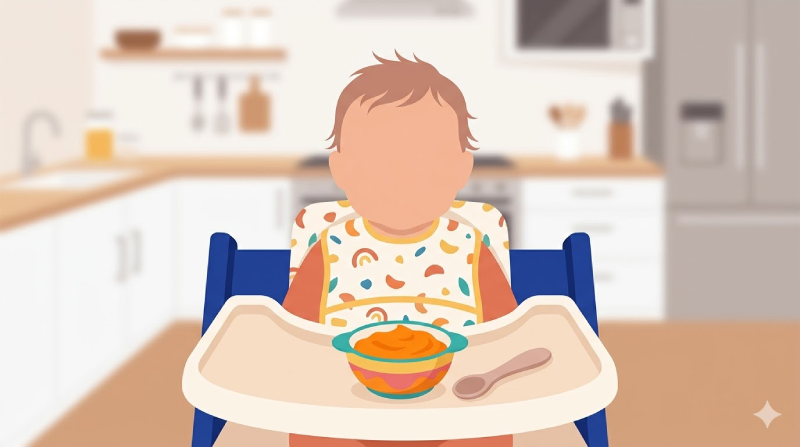
The American Academy of Pediatrics recommends introducing solid foods at around 6 months of age and explicitly states that no solids should be introduced before 4 months. This guidance is based on decades of research: before 4 months, the digestive system is not mature enough to process anything other than breast milk or formula, and introducing solids too early has been associated with increased risk of obesity, food allergy, and digestive issues in later childhood.
The word "around" is intentional. There is no developmental advantage to starting on the exact day of a baby's six-month birthday. Some babies show clear readiness at 5.5 months; others are not genuinely ready until 6.5 or 7 months. The readiness signs described below are more reliable guides than the calendar — and when readiness signs are present closer to 4 months, current guidance is still to wait until 6 months unless advised otherwise by your pediatrician.
For premature babies, use corrected age (age from the original due date) rather than chronological age when thinking about readiness. A baby born 8 weeks early who is now 6 months old chronologically is developmentally closer to 4 months, and their readiness timeline adjusts accordingly. Always confirm the timing with your pediatrician for premature infants.
Signs of Readiness (All Three Must Be Present)
Readiness for solid foods is defined by three physical developmental milestones, all of which must be present before starting. Meeting two out of three is not enough — the combination matters because each sign reflects a different system that needs to be functional for safe and productive eating.
Sitting with minimal support and holding the head steady. A baby needs enough core and neck strength to hold themselves upright while food is placed in their mouth, chew or move food with their tongue, and protect their own airway by controlling their head position. A baby who slumps or cannot maintain head stability is at higher risk of choking.
Loss of the tongue-thrust reflex. Newborns are born with a protective reflex that automatically pushes foreign objects out of the mouth — this is why young babies spit out everything that is placed on their tongue. This reflex fades between 4 and 6 months. A baby who consistently pushes every spoonful out with their tongue has not yet lost the reflex and is not ready for solids, regardless of age.
Showing interest in food. A baby who is ready watches others eat with intent focus, reaches toward food on a plate, and opens their mouth when food approaches. This interest reflects cognitive readiness, not just physical readiness.
It is also worth naming what are not readiness signs — three common misconceptions that lead parents to start solids too early. Waking at night is usually caused by sleep regressions or developmental phases, not hunger that solids would solve; research consistently shows that starting solids does not improve night sleep. Chewing fists is normal oral exploration present from birth, not a hunger signal. And watching you eat is curiosity about an interesting social activity — without the other signs, it is not a readiness indicator.
First Foods: Purées vs Baby-Led Weaning
There are two broadly accepted approaches to introducing solid foods, and most families end up using elements of both.
Purées (the traditional approach) involve smooth or semi-smooth foods fed by spoon. This method makes it easier to control texture progression, monitor the volume consumed, and introduce specific foods systematically. It is particularly useful in the first weeks of solids when you are tracking new food introductions and watching for any reactions.
Baby-led weaning (BLW) skips purées entirely and starts with soft finger foods that the baby self-feeds. Proponents of BLW point to evidence suggesting it promotes better motor development, self-regulation of intake, and a wider palate for varied textures. The key requirement is that foods must be genuinely soft — soft enough to mash between your finger and thumb — and shaped for easy grasping (think a strip of soft-cooked carrot, not a round coin-shaped piece).
A combination approach — offering some purées by spoon alongside appropriate soft finger foods — captures the benefits of both and is how most families naturally proceed. There is no evidence that one approach produces better outcomes than the other for typically developing babies.
First food options by category
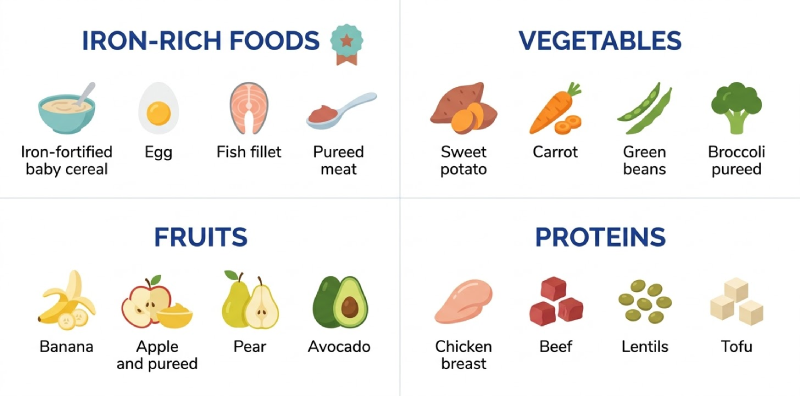
Iron-rich (prioritize these): puréed meat (chicken, beef), lentil purée, iron-fortified single-grain cereal
Vegetables: sweet potato, butternut squash, peas, green beans, zucchini — all steamed and puréed or soft-cooked for BLW
Fruits: ripe banana (mashed), avocado (mashed), soft-cooked pear, ripe peach — naturally soft textures
Proteins: well-cooked egg yolk (also an allergen — see below), smooth nut butters mixed into purée, full-fat plain yogurt (dairy allergen)
Iron deserves special emphasis: breast milk is relatively low in iron after 6 months, and a baby's birth iron stores begin to deplete around this time. Iron-rich first foods are not merely a nice-to-have — they are a nutritional priority at this stage.
Early Allergen Introduction
One of the most significant shifts in infant feeding guidance over the past decade is the recommendation around allergen introduction. The LEAP (Learning Early About Peanut allergy) study published in 2015 demonstrated that early, regular introduction of peanut to high-risk infants dramatically reduced the rate of peanut allergy compared to avoidance. Subsequent research on other allergens has reinforced this direction: for most babies, early introduction of the top allergens — rather than avoidance — is now recommended.
The current guidance from AAP and ACAAI is to introduce peanut, egg, and other top allergens starting around 6 months for low-to-moderate risk babies, and as early as 4–6 months (under medical supervision) for babies with severe eczema or existing egg allergy, who are at higher risk. Do not wait until after the first year to introduce these foods.
Top 9 allergens and how to introduce
Peanut: smooth peanut butter thinned with warm water or breast milk, mixed into purée — never whole peanuts
Tree nuts: almond butter, cashew butter — same method as peanut
Egg: well-cooked scrambled egg or hard-boiled yolk mixed into purée
Milk: plain full-fat yogurt or small amount of cheese (not cow's milk as a drink under 12 months)
Wheat: small amount of wheat-containing cereal or bread
Soy, fish, shellfish, sesame: small amounts mixed into familiar foods
Protocol: introduce one new allergen every 2–3 days · offer at home during morning or midday (not near bedtime) so you can observe for 1–2 hours after
Signs of an allergic reaction typically appear within 2 hours of introduction. Mild signs include hives, small raised welts, vomiting, or increased fussiness. Severe signs — difficulty breathing, swelling of the lips or tongue, blue or pale skin, sudden extreme lethargy — require calling emergency services immediately. For mild reactions, contact your pediatrician before offering the food again. Having infant antihistamine available (as directed by your provider) is reasonable preparation.
How Much to Feed at the Start
The purpose of solid foods at 6 months is exploration and learning, not nutrition. Breast milk or formula remains the primary source of calories and nutrition until 12 months. This framing helps take the pressure off — if a 6-month-old eats half a teaspoon of sweet potato and spits out the rest, that is a successful first feeding.
Start with 1–2 teaspoons of a single food once per day, gradually increasing volume as the baby shows interest and skill. Increase slowly — both the amount per meal and the number of meals per day — watching hunger and fullness cues at every step. Never force a baby to finish a portion. Division of responsibility applies from the first meal: the parent decides what food to offer; the baby decides whether and how much to eat.
By 9 months, most babies are eating 2–3 small meals per day with thicker textures and a wider variety of foods. By 12 months, the goal is 3 meals plus 1–2 snacks per day, with the family's food (appropriately textured) increasingly at the center of meals, and cow's milk replacing breast milk or formula as the primary dairy drink if desired.
Tracking what has been introduced — and when — is genuinely useful in the early solids phase. If a reaction occurs, knowing exactly what was offered in the previous 2–3 days and in what combinations makes identification far easier. For a broader view of developmental milestones to track alongside first foods, see our guide on tracking baby milestones. For reference on how feeding volumes shift as solids are introduced, see how much a newborn should eat.
Foods to Avoid in the First Year
While the first foods list is broad and encouraging, there are several foods that should be avoided entirely in the first twelve months, for reasons ranging from serious infection risk to choking hazard.
Honey — in any form, including baked goods that contain honey — must not be given to babies under 12 months. Honey can contain spores of Clostridium botulinum that are harmless to adults but can cause infant botulism, a rare but life-threatening condition caused by toxin production in the immature infant gut. Cooking does not destroy the spores.
Cow's milk as a main drink should not replace breast milk or formula before 12 months. Cow's milk does not provide the right balance of iron and nutrients for infants at this stage, and its protein and mineral content can stress the immature kidneys. Small amounts of dairy as an ingredient in cooking (cheese in a sauce, yogurt as a food) are fine.
Added salt and sugar should not be added to any food prepared for babies under 12 months. Their kidneys cannot process excess sodium, and introducing sugar early establishes taste preferences that are difficult to shift. Cook without adding seasoning, then season the adult portions afterward.
Choking hazards to avoid throughout the first year include whole grapes (cut into quarters lengthwise), raw hard vegetables (raw carrot, apple), whole nuts and seeds, large chunks of meat, and anything round, firm, and small enough to block an airway. The shape and texture matters as much as the size.
Log Food Introductions in BabyJot
The early weeks of solid foods involve introducing a new food every few days, monitoring for reactions, and building a picture of what the baby accepts, refuses, and reacts to. Trying to hold this information in memory — especially while also managing a sleep- deprived household — is unreliable. Logging each introduction with date, food, and any notes about response takes thirty seconds and provides a permanent, searchable record.
BabyJot lets you log food introductions alongside feeding volumes, sleep, and diaper data — so if a reaction occurs, you have a complete timeline of the previous 24–48 hours ready to share with your pediatrician. No account required.
Latest Articles

First Week With a Newborn: What No One Tells You

Newborn Sleep Patterns: What to Expect Week by Week
Tracking Baby Milestones: What to Log and Why It Matters

Breastfeeding vs. Formula: A Practical Guide for New Parents

Newborn Jaundice: What Parents Need to Know

Understanding Baby Growth Charts: Percentiles Explained

Baby Sleep Regression: Ages, Signs, and What Actually Helps

Safe Sleep for Babies: AAP Guidelines Every Parent Should Know
Baby Nap Schedule by Age: How Many Naps and How Long
Pumping Breast Milk: Schedule, Storage Guidelines, and Tips

How to Prepare for a Pediatrician Visit: What Data to Bring

How Much Should a Newborn Eat? Feeding Amounts by Age
Baby Diaper Guide: What's Normal and When to Worry
